Spread or staking? What a small NEAR Intents solver can earn
After Intents Desk we asked a follow-up question. Could a small solver on NEAR Intents make money? And could the NEAR it holds also earn staking yield while it waits?
This note has the answer so far. It comes from public chain data, the official docs and a solver we built to run in dry-run only. It uses no keys and no funds. Nothing here is financial advice.
How a solver earns
A user asks for a swap. Solvers answer with signed quotes. The best quote wins, and the trade settles in the Verifier contract, intents.near. The solver keeps the spread between its quote and the market price, minus the protocol fee (fees) and the cost of hedging.
Quotes are firm. Once the user picks yours, you fill it. There is no "last look", so every check has to run before the quote goes out.
What public fills show
We replayed public intents.near fills from 6 November 2026 against two exchange price feeds. We used chain data only, never 1Click API data. The question was whether quoting the market mid minus a margin would have won those orders.
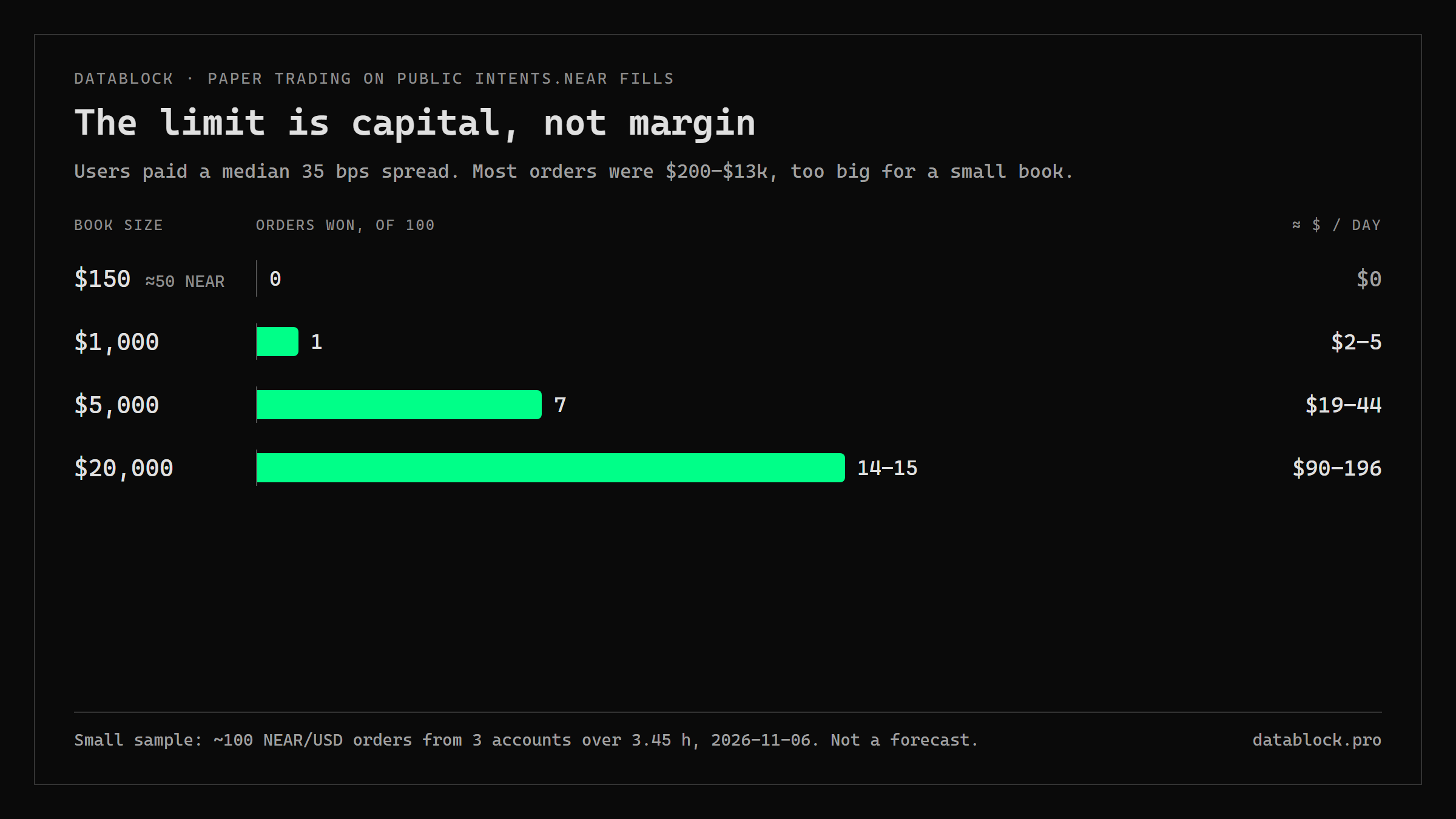
- Users on NEAR/USD routes paid a median spread of about 35 bps. That leaves room for a solver quoting 10 to 30 bps.
- Most orders were $200 to $13k. A book of 25 to 50 NEAR (about $150) can't quote them, so it won none.
- The sample is small: about 100 orders from 3 accounts over 3.45 hours. The $/day figures are rough extrapolations, not a forecast.
So for a small solver the limit is capital, not margin.
Spread or staking
More capital raises the next question: can it earn staking yield while it waits for orders?
The Verifier accepts NEP-141 tokens by ft_transfer_call and keeps balances as NEP-245 (deposits, balances). Native NEAR has to be wrapped to wrap.near first. Wrapped NEAR earns no staking reward. So NEAR held as solver inventory earns the spread when it trades, and nothing while it waits.
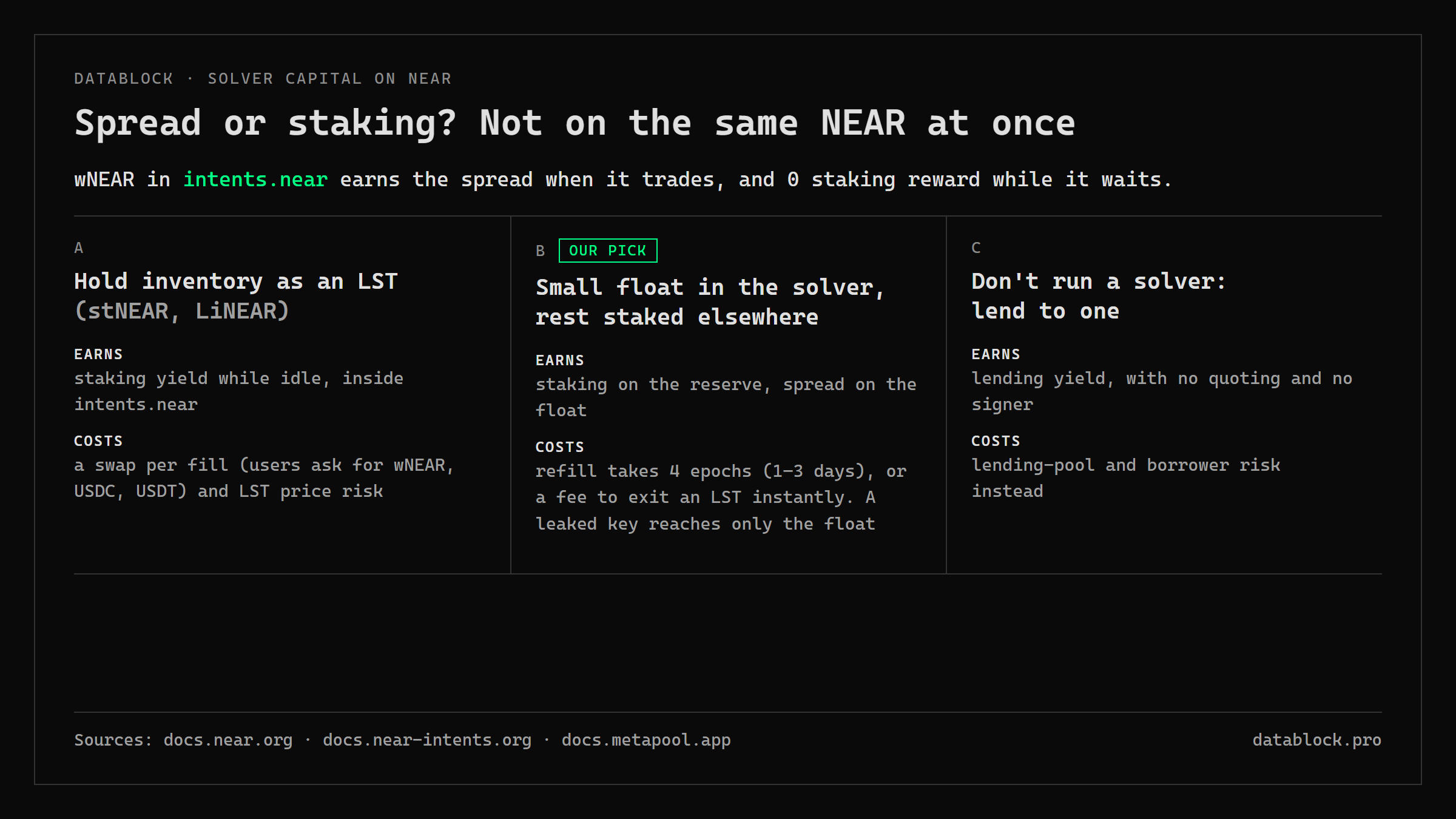
A. Hold inventory as a liquid staking token. stNEAR or LiNEAR keeps earning inside intents.near. But the public flow we saw was wNEAR, USDC and USDT, not staking tokens. Each fill would need an extra swap, and the solver carries the token's own price risk.
B. Keep a small float, stake the rest. This is our pick. The solver holds only what it needs to quote. The rest stays staked in a separate account. Refills are the cost:
| Exit | Time | Cost |
|---|---|---|
| Native unstake | 4 epochs; sources give about 1 to 3 days (NEAR docs) | none |
| Meta Pool delayed unstake | 4 to 6 epochs, 48 to 72 h (Meta Pool) | none |
| Meta Pool fast unstake | immediate | liquidity fee, 0.3 to 3% per the FAQ (Meta Pool) |
| Swap the staking token on a DEX | immediate | pool fee and price impact |
The float has to cover a few days of fills, or every refill pays an instant-exit fee. B has a security benefit too: a leaked solver key can only reach the float.
C. Lend to a solver instead. Lending pools such as Rhea's lend to solvers. Lenders earn without quoting, running a signer or going through solver KYC. They take on the pool's risk instead.
We don't quote an APY here. Check the live rate on the pool or token page before you rely on one.
We built the solver in dry-run first
Before any live test we built the full quote path and ran it against replayed events:
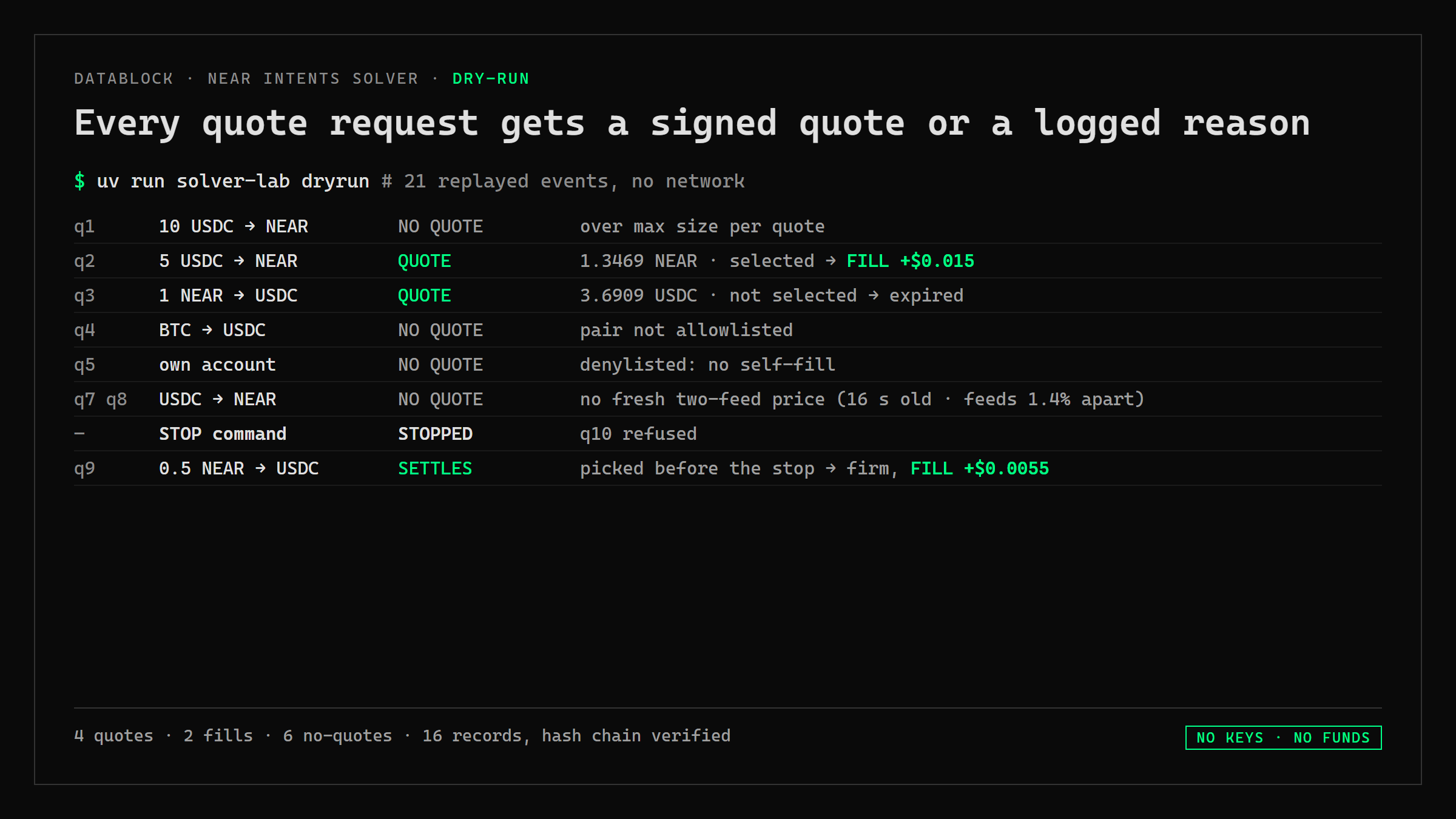
- A quote loop. Each request gets a signed quote or a logged reason: too big, pair not allowed, our own account, stale prices.
- A separate signer process. It holds the key, loads its limits once at start, checks its own price floor and keeps an hourly and daily budget. The quote loop can't hand it new limits.
- Risk limits. Size per quote, inventory, exposure counting open quotes, and a daily loss limit.
- A kill switch. A stop file and a stop command. Quotes picked before a stop still settle, because quotes are firm.
- An append-only record log. Each record carries the hash of the one before it, so a gap or an edit shows.
The dry-run signer makes a throwaway key in memory and connects to nothing. Every reply says DRY-RUN.
What comes next
- Security review and re-audit of the signer.
- Solver KYC/KYB before any live key.
- A live test only with capital that the numbers above say can win orders.
If you run a solver or build a staking token on NEAR, we'd like to compare notes. You can also send me a message.