


Intents Desk: what we are submitting to NEAR HACKATHON
NEAR HACKATHON closes on 14 November 2026 at 23:59 UTC (rules). Our entry is Intents Desk, a live reliability desk for swaps on NEAR Intents.
Try it: intents.datablock.pro. Paste a 1Click deposit address, or look at the refund rates by partner. This note is the summary of the submission: what the product does, what it found, how we test it, and which claims are still not proven.
The product page is Intents Desk. For the day-by-day detail, read the build log. For the data model behind it, read NEAR Intents passed $30B.
The problem
When a swap on NEAR Intents is stuck or refunded, the user gets little help. One r/nearprotocol user wrote that a swap "has not refunded or completed the swap in 4 days" (thread, 22 October). The 1Click API moves tens of millions of dollars a day. The official Intents Explorer shows the status of each swap, but nobody publishes the refund rate per app or per route. Apps that route swaps through 1Click have the same gap: when their integration breaks, they learn it from support tickets.
What Intents Desk does
- Where's my swap? Paste a deposit address. See the status, the refund reason if there is one, and what to do next.
- Network health. The refund rate per hour. A partner alerts when it has at least 50 swaps and at least 50% refunded in one hour.
- Partner pages. Swaps, refund rate, routes and refund reasons per partner. Aggregates only.
- Wallet sign-in. You sign a message (NEP-413). Sign-in sends no transaction, so it costs no fee and puts no funds at risk.
- Telegram alerts. After sign-in, watch a swap. The bot sends one message when its status changes.
- What people report. Recent public posts about stuck swaps from X and r/nearprotocol.
- A thesis report. A dated report where every number comes from one named SQL file, so anyone can run it again.
- An agent. An IronClaw skill on NEAR AI answers "where's my swap?" in about 140 bytes.
What it looks like
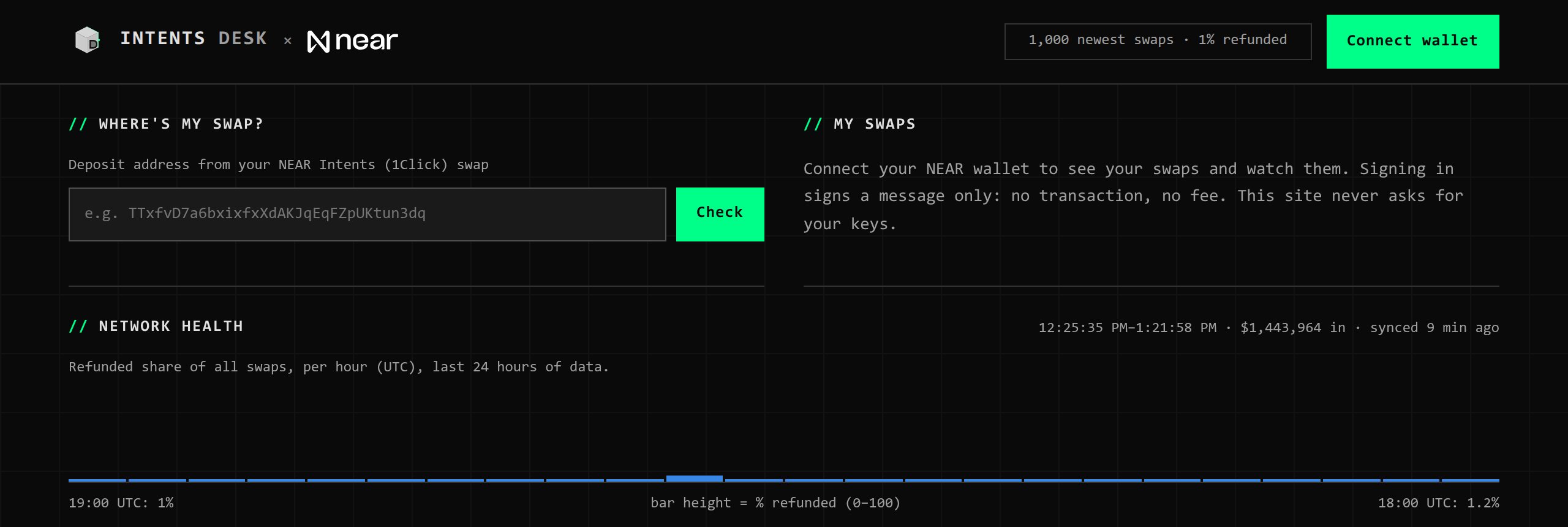
The dashboard on 6 November. Paste a deposit address to check a swap, or connect a NEAR wallet to watch your own. The chart shows the refund rate per hour. This was a quiet day: 1% of the 1,000 newest swaps were refunded.
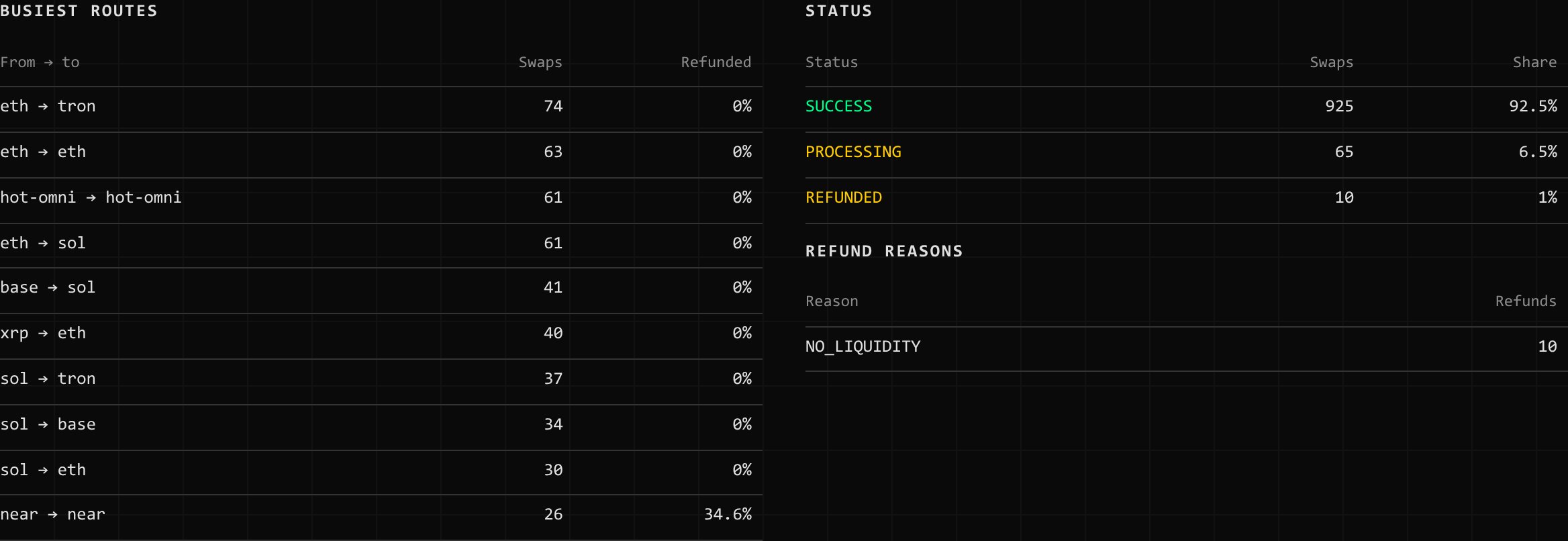
Busiest routes, status and refund reasons for the 1,000 newest swaps. The partner table is not shown here, because it names the integrations.
What it found
In its first day, Intents Desk found one widget integration that failed almost every swap. These numbers come from a snapshot on 5 November at 14:28 UTC, which covers 41.5 hours:
| Measure | Value |
|---|---|
| All swaps in the window | 76,860 ($77.5M in) |
| Swaps from the failing integration | 43,541 |
| Refunded, failing integration | 95.2% |
| Refunded, all other swaps | 2.2% |
INTENT_SUBMIT_FAILED refunds from the integration | 41,456 of 41,457 |
| Incident start and end | 13:05 UTC 4 November to 13:08 UTC 5 November |
The partner alert fires in the first hour of the incident. We sent the hourly numbers to the integration's team in private before any public post, and we do not name them here.
Refunded USD is not lost money. A refund returns the funds. The same senders retry, so the refunded USD counts the same funds many times. The cost is failed swaps, fees and time.
How it is built
One Python server holds one DuckDB file in three layers: the raw API responses, one row per swap, and hourly aggregates per partner and route. A sync thread reads the last 2 hours of swaps every 10 minutes and updates each swap by key, because a swap changes status after we first see it.
Rules we keep:
- Public data only. We hold no keys and no user funds.
- Raw 1Click data for 24 hours at most, as the 1Click API terms ask. Before we delete raw rows, we roll each complete hour into the aggregate tables. An hour is written once and never replaced.
- No full addresses in public lists. The recent-swaps list shows a short address and an opaque reference.
- An audit row for every job. Each sync, rollup, report and backup writes its start, end, status, row count and code version.
- Backups we can check. A daily Parquet export carries a manifest with row counts and SHA-256 hashes. We check the hashes again after the copy.
How we test it
Every push runs a local gate before the code goes to GitHub:
- Fast: unit tests, data tests, and integration tests against local fakes of each API.
- Full: the fast tier, plus live contract tests against the real APIs, a parse-speed limit, a secret scan, a dependency audit and a container build.
- UAT: the app starts, and browser tests run against it, including NEP-413 sign-in with a test wallet.
Phones needed work. The page first waited for the wallet library before it showed any data. Now the library loads after the data, and the wallet asks for one signature only. On a mid-range phone profile (4× slower CPU, 1.6 Mbps, median of 5 runs), the first data shows in 0.66 s instead of 0.82 s, and a visit downloads 49 KB instead of 135 KB.
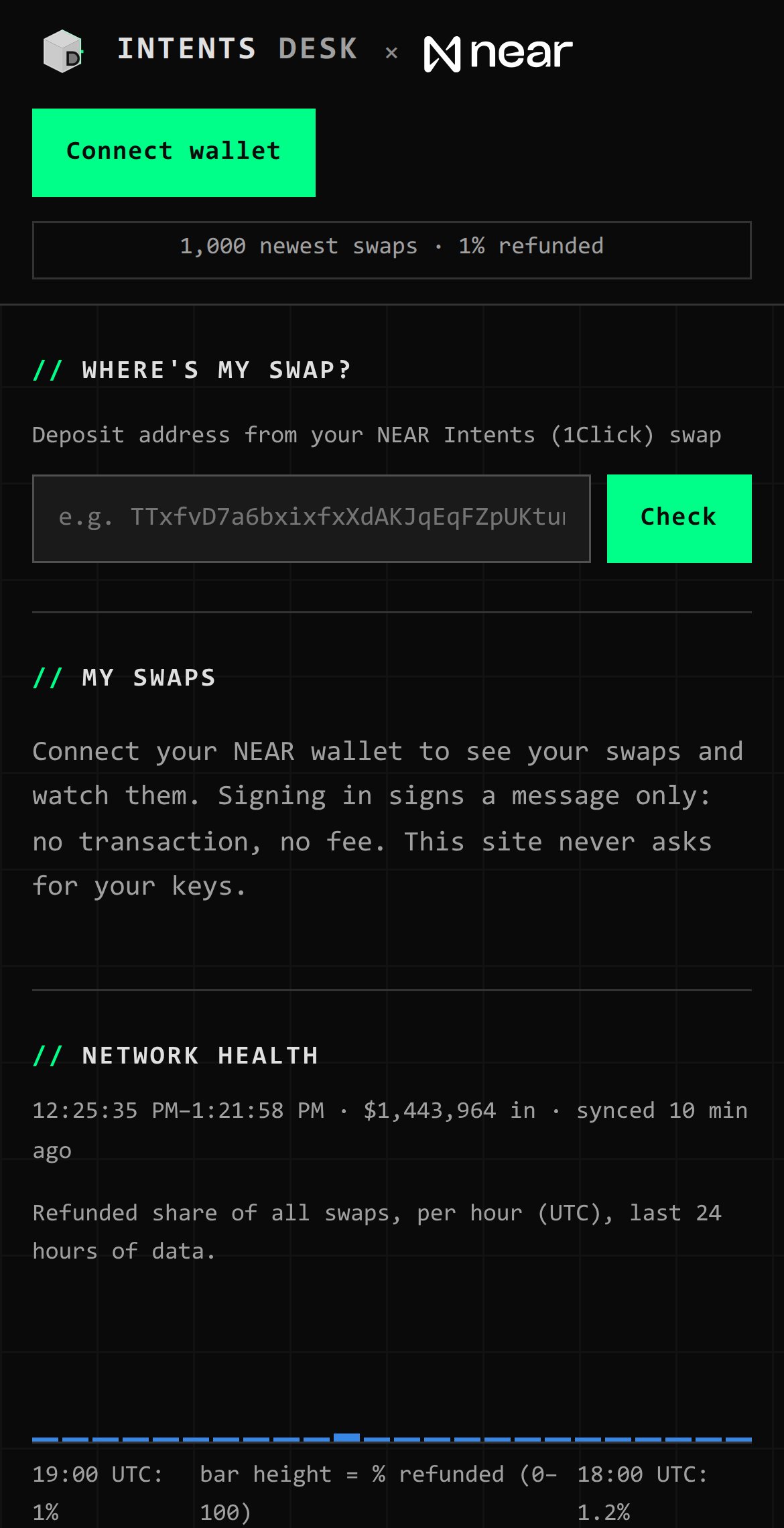
Intents Desk on a phone-sized screen.
Tracks we enter
A project can enter every track it fits. These are the tracks that Intents Desk fits best:
| Track | Why it fits |
|---|---|
Investment Thesis (thesis) | A re-runnable report on 1Click reliability, with every number tied to SQL |
Real-World Money (realworld) | Apps that move users' money need to know when swaps fail |
Agent Economy (agents) | An IronClaw agent answers swap questions from the same data |
AI Security & Defense (security) | Partner alerts flag a failing integration in its first hour |
What is proven and what is not
| Claim | Status |
|---|---|
| Catch a failing integration in the first hour | Seen once, on 4 November |
| Users need help with stuck and refunded swaps | Public complaints on X and Reddit |
| Public reliability numbers from SQL | Built: the thesis report |
| The agent answers "where's my swap?" | Works in a terminal test on NEAR AI. Not yet confirmed in the web chat |
| A swap from the app, with a 0.40% app fee | Built. Off until we finish reading the 1Click partner terms |
| Partners pay for alerts and reports | Not proven. No partner has signed up |
The desk shows its value on bad days. On a quiet day, it says "all fine". So we offer it as insurance, and the 4 November incident is the proof.
What we cannot see yet
- 1Click swaps only. Swaps that use
intents.neardirectly are not in this data. - A short window. About two days of data is not a trend.
- Fill time is an upper bound. We measure to the last status change, not to the settlement itself.
For apps that route swaps through 1Click
If your wallet or widget sends swaps through 1Click, we can send you:
- an hourly alert when your referral id passes the refund threshold;
- a weekly reliability report: refund rate, refund reasons, and fill time per route.
Send us your referral id, and we send you last week's report for free. Pricing: contact us. You can see the live numbers first at intents.datablock.pro.
If your app routes swaps through NEAR Intents, I can set up the swap tables, the partner alerts and the weekly report with you. You can also send me a message.